

Heidi Borner contacted PeruNorth in October 2025 interested in the Rio Amazonas Research Station. During the booking process, she mentioned:
“I do research with the community in New Zealand on the health of our river system and coastal ocean area and the rocky shore. We are working to rewild the area.
I am keen to see what wildlife you see at Rio Amazonas and what methods you use to monitor biodiversity.”
Heidi and her partner, Jonathan Everest, boarded the research station in late April 2026, and this is what they say about the four-night experience:
‘Yes, we did visit communities. We visited the museum at Omaguas, and Jaldar, a community within the Amazon a short distance from the Rio Amazonas boat.
The little museum at Omaguas is in development and holds some interesting history, which was great to learn about. That was perhaps the best viewing of a pink dolphin (a line drawing), as I discovered they are quite difficult to photograph!
Jaldar was interesting because Niki, who was visiting from the US, was underway with a craft project with the community to exhibit their work at Omaguas. Great to see this community link. We bought some interesting handicrafts and played with the kids a bit. It was fun.
We did 3 - 4 x 2-hour small boat rides per day and night to count the different animals.
Shore birds
Bats (night)
Fishing
Macaws, Parrots and Parakeets
Caimans (night)
Terrestrial Transect #5 on land to find mammals
Shore birds by canoe
Frogs (night)
Dolphins
Jaldar
All of it was amazing. Just to sit in the heart of the Amazon and hear the animals going about their business was something I will remember forever.
I wanted to see how the science worked and biologists Paola and Osnar were great at finding things and explaining in depth about the animals.
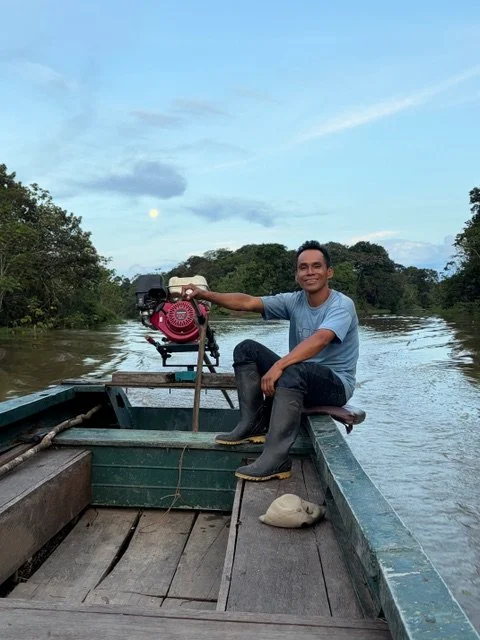
Rome, the boat driver … and wildlife spotter!
Rome, who guided the boat and our jaunts, was a super guide who could spot many things, including a snake that was gliding by on our path.
Kim was working with Niki and was also a fantastic resource and her planning made the trip varied and interesting.
The kitchen staff catered very well for us. The food was basic but tasty, and I appreciated very much being in their safe hands to manage my allergies. They were quite creative!
The little boats that we used were basic, and we appreciated the cushions to sit on. It is otherwise a long time to sit on vibrating wood every day.
The umbrellas to keep the sun off were a must. We found it very hot, especially because we had to wear long sleeves and pants etc for the sun and the mosquitoes. When moving on the water there was a bit of a breeze which helped.
The Terrestrial Transect was not far (maybe 6 km) but it was so hot and we had to walk slowly, so it was very hot for us. I would not have wanted to miss it because it was fun, but it was really hot.
We didn’t get many bites because we were pretty good about covering up. I did wear the mosquito net attached to the hat which kept the mosquitoes off my face which I really found effective.
Physically, we did really well. We were still sore from the Inca Trail, so Jono found his knees hurt in the boat. But he is still hobbling now so we can’t attribute all of it to the boat rides!

Jonathan recording wildlife seen on an Amazon tributary.
The taxi and the boat to and from Iquitos were efficient. It is a long way.
I was really excited to see all the different animals we managed to see. Paola and Osnar saw way more than we did, but they were patient with us and we did take time to see the animals move around.
Liked the sloths - we watched them for a while. It was great to see animal behaviours as well, not just to see them but to see them interact with their environment.
The Macaws and Parakeets are always fun and it is interesting to see how they interact in their groups. The monkeys also - I didn’t expect several species interacting in the trees while they were feeding. In zoos, each species sits by itself.
The fishing trip was great - we saw piranhas up close!
And of course the pink and grey dolphins were a thrill! They were surprisingly hard to view and video or photograph. We did try on many occasions and we got a few blurry photos but that is all part of the experience. We weren’t expecting them to pose! The best viewing was a group of 5 with a baby, a juvenile and 3 adults and you could see them interacting, which was special.
The accommodation was interesting. The station is made up of old and run-down boats with a lot of history.
The beds were very clean and comfortable, the mosquito nets worked, and the air conditioners were very appreciated.
The bathrooms were a little problematic because we initially had a toilet that didn’t work so we had to change rooms. The next room had a leaking toilet which they managed to fix. It was great to have a shower at the end of the day.
Wood in the humid and hot environment has led to the boat being quite mouldy, which is not really surprising. I took extra allergy medicine to counter the effects of that. I tried to visit the library but it was just too heavily mouldy for me.
We did sleep well every night because the beds were so good. So, a mixed bag. The warmth and hospitality of the crew more than made up for it.
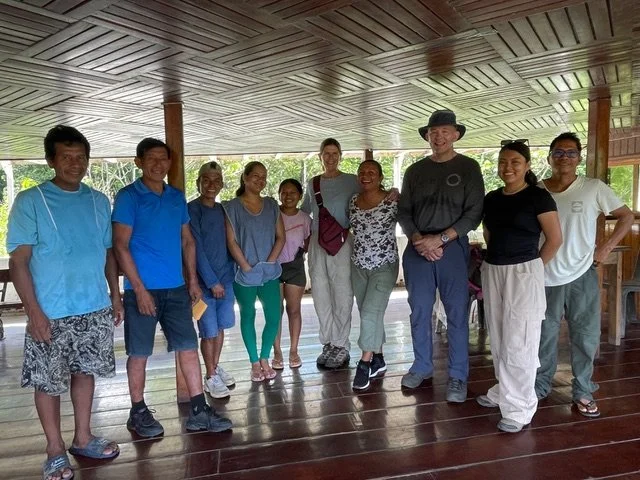
Heidi & Jono posing with the research station crew.
The internet was amazingly good!
In terms of the cultural impact, Jaldar village was just starting to make handicrafts for purchase. There were about 10 vendors and just the 2 of us, so we felt a bit bad that we couldn’t buy from all of them. Some looked a bit disappointed. It is a hard balance to bring visitors in for a meet and greet, but also expect them to buy stuff …
… The craft purchases definitely went to the village. In terms of the money we paid to stay on the boat and participate in the science, we felt that the money was going to the people on board as their salaries, which was good. It felt like our money was contributing to tracking changes in the Amazon, which we were happy about. To offer this science experience is really valuable for visitors to the area.
I was excited to hear that some girls’ schools from Montreal had visited - I wish that had been me many years ago. That would have changed the course of my life!
We did have some talks about environmental issues from the guides - unpredictable increase and decrease of the Amazon river water levels was the main topic. It was interesting to understand the connection from the Urubamba River to the Amazon. We had seen the Urubamba River and the surrounding countryside earlier on our trip. The importance of this waterway is so critical to planetary health.
While the rest of Peru had lots of plastic garbage (the Inca Trail was ok), the parts that we saw in the Amazon were not too bad. I expected more after what we had seen in Peru and Ecuador. So that was a good thing.

Paola showing the way to the motorboat at Jaldar.
We did notice the biologists’ warm interactions with the kids in Jaldar. It is obvious that they have spent time with the kids who gave us their lovely drawings of animals. Even little ones had drawn for us. That was so cool.
This was indeed a memorable time. It was such a joy to visit the Amazon with the crew, guides, and scientists at the Rio Amazonas station. To see the vast amounts of long-term environmental data they are collecting is so valuable. And to see how the new scientists have opportunities to do field work close to home means they can grow into knowledgeable practitioners to advocate for the health of the Amazon at a global level.
We were grateful to have this experience and to be so well looked after. Thanks to the whole team. xo’