
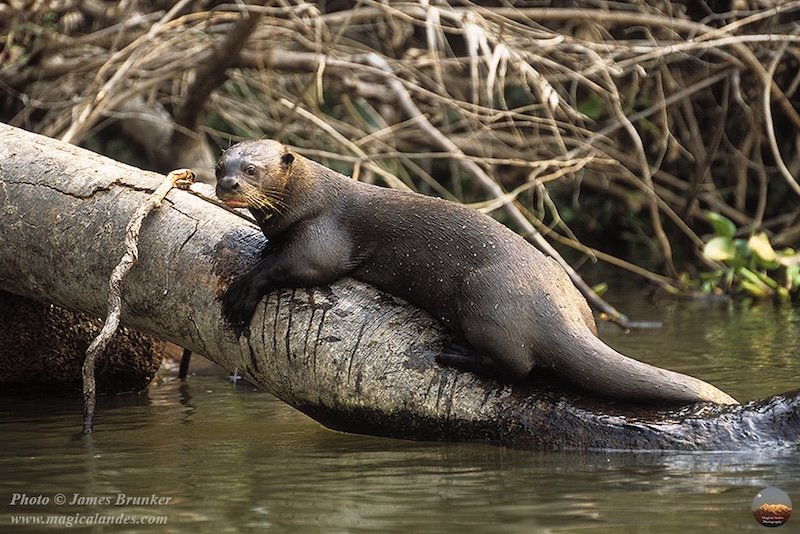
Peru is home to three species of otter: the South American Sea Otter (Lontra felina), found along Peru’s extensive coastline; and the Neotropical (Lontra longicaudis) and Giant River Otters (Pteronura brasiliensis) found in Amazonia … with the latter also known as Giant Amazon Otters.
Giant Amazon Otter in oxbow lake.
Here are nine key facts about these Giant Amazon Otters, and how you can incorporate them in a Peru visit:
Taxonomy: The Spanish name for the giant otter, lobo de rio (river wolf) is misleading, as they are in fact members of the mustelid family which includes weasels, badgers, polecats, martens, grisons and wolverines.
Size: The giant otter is the longest of the mustelids, reaching up to 1.8m (nearly 6ft) in length. Its tail can account for about half of its total length.
Adult males are generally larger than females, typically weighing 26 - 32 kg (51 - 71 lbs).
Appearance: Giant otters have thick fur that provides insulation in cold water, and webbed feet for swimming. Their strong, elongated body aids in their aquatic lifestyle.
Each otter has unique, light-coloured markings on their throat and chest - often called a ‘throat patch’ - that function like fingerprints, allowing other otters (and researchers) to identify individuals. These markings are white to yellow-buff in colour, and vary in size, shape, and pattern for each otter, sometimes forming spots or a bib.
When meeting, giant otters may ‘periscope’ (ie raise their heads and chests out of the water) to display these unique markings to each other.
Diet: Their diet primarily consists of fish, but they also consume crustaceans and small mammals.
They are known for their efficient hunting techniques and can dive up to 9m (30 ft) underwater.
Lifespan: In the wild, giant otters can live around 10 years, while those in captivity may live longer, often up to 20 years.
Habitat: These otters primarily inhabit freshwater rivers, lakes, and swamps in the Amazon Basin, although they can also be found in some areas of the Pantanal wetlands.
Social Structure: Unlike many other otters, giant otters are highly social and often live in family groups, which can consist of up to 10 individuals.
They communicate through a range of vocalisations, including chirps and growls.
Reproduction: Mating usually occurs in the water, and females give birth to one to five pups after a gestation period of about 65 to 70 days.
Pups are born blind and rely heavily on their mother and the group for care.
Conservation Status: Currently listed as endangered due to habitat loss, fishing pressure, and hunting. Conservation efforts are underway in various parts of their range to protect their populations and habitats.
Understanding the behaviours and habits of giant otters can contribute to ongoing conservation efforts and highlight their importance within aquatic ecosystems.
How to see Giant Otters in Peru:
Giant River Otters can be found throughout Peruvian Amazonia, but are most closely associated with oxbow lakes in Tambopata Reserve.
Sandoval Lake Lodge overlooks one of these oxbow lakes, which is known to be home to a family of giant otters. A number of other lodges include a visit to Sandoval Lake in their itineraries, as it is both beautiful and wildlife-rich.
Tres Chimbadas is another oxbow lake with a Giant Otter population, and is offered as a visit from Posada Amazonas.
A family group of Giant Amazon Otters.
If going to the Amazon jungle around Iquitos, your best bet for seeing otters is at one of the more remote lodges upstream from the city, such as Tahuayo or Muyuna. They are present year-round, but July, August and September are the best time to see them, as falling water levels make them easier to spot.
For more information, please get in touch.